



More than 5000 satisfied customers worldwide













































Why most training for managers doesn't stick
Most line managers get the job because they were good at something else. The Chartered Management Institute calls them “accidental managers”: in the UK, 82% of people who step into management have had no proper management and leadership training. What training they do get is often a two-day workshop, and on Monday they are back with their team having practised nothing.
Line manager training works when it runs the other way round. Pick the few skills that make or break a first team (delegation, feedback, motivation, coaching and conflict), let managers practise each one in a realistic situation where mistakes cost nothing, and spread the practice over weeks so they can try it with their real team in between.
Our simulations are built for exactly that: a short game, decisions with consequences and personalised feedback. For the full method, read our guide to management training and development, or go straight to performance management training for managers.
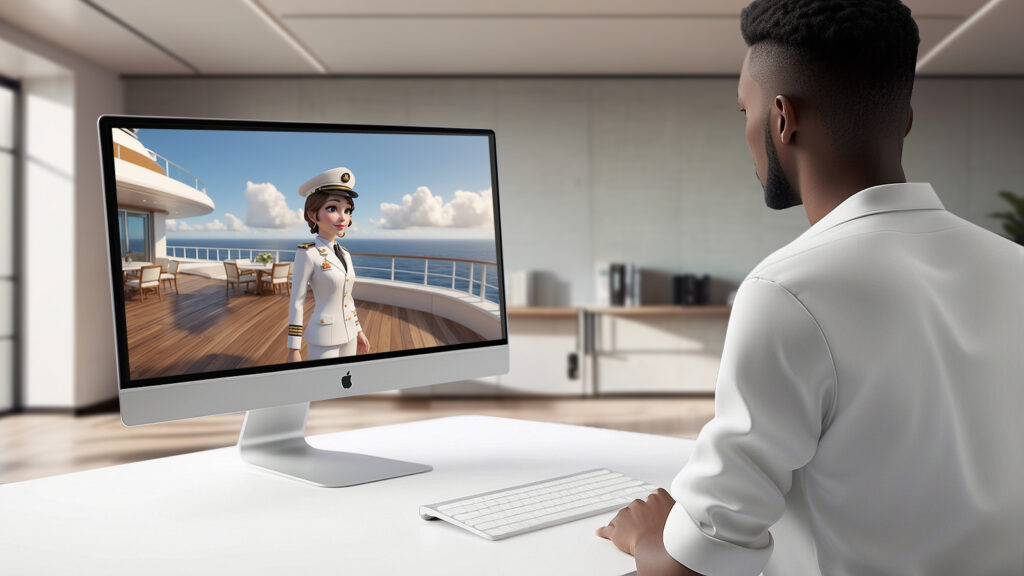
The skills every line manager needs, and the simulation that trains each one
Pick a skill to see what your managers practise and which game in our catalogue covers it.
Leading and managing a team
Pacific is our complete leadership and team management game: about 8 hours across six modules. Stranded on a desert island, managers practise building trust, motivating, resolving conflict, delegating, giving feedback and assessing performance.
Delegating without losing control
In Sahara, managers act as consultants to a startup heading for bankruptcy because nobody delegates properly. In about 70 minutes they learn a six-step delegation process and practise it in the simulator until it comes naturally.

Feedback and performance conversations
The Airport (about an hour) teaches the SBI model: how to prepare a feedback session, when and whom to ask for feedback, how to take it without getting defensive and how to give it clearly. Aqua (about an hour) adds a dozen practical cases of positive and constructive feedback that change behaviour.


Keeping people motivated
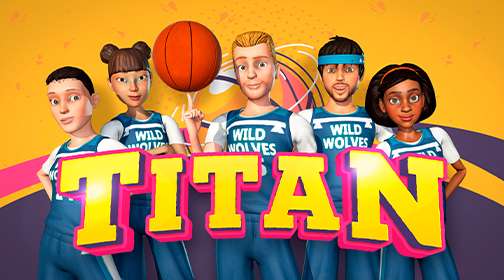
Titan follows a basketball coach whose team is about to be knocked out of the league. In about 75 minutes managers learn which factors motivate a team, how to find out what drives and what discourages each person, and how to keep motivation going over time.
Coaching training for managers
Echo runs three simulated coaching sessions (about 2 hours) in which managers help a coachee define objectives, analyse the reality, explore alternatives and design an action plan, practising open questions, empathy and neutrality.

Leading remote and hybrid teams
Stellar sends managers on a space mission with a team spread across different locations. In about 2 hours they practise setting goals at a distance, communicating without sharing an office and keeping people motivated.

Handling conflict in the team
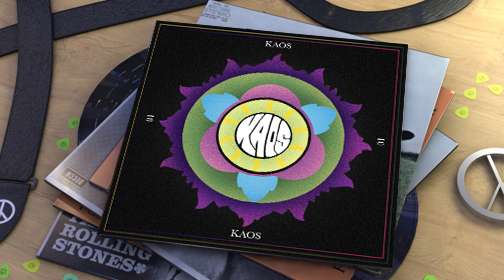
KAOS is a rock band a week away from its big gig and about to fall apart. In about 45 minutes managers learn a method to mediate: set the ground rules, listen to every side, agree a solution, make it stick and spot the next clash early.
Management training for new managers: a 12-week example
One skill every two weeks, a short game, one real task with the team and a quick check-in with their own manager.
- 1
Weeks 1–2 · Delegation
Play Sahara, then delegate one real task with a clear outcome and a checkpoint. A short chat with their own manager before and after.
- 2
Weeks 3–4 · Feedback
Play The Airport and Aqua, then give one piece of positive and one piece of constructive feedback using SBI, and note how each one landed.
- 3
Weeks 5–6 · Motivation and one-to-ones
Play Titan, then hold a one-to-one with each team member about what drives them and what gets in the way.
- 4
Weeks 7–8 · Conflict and difficult conversations
Play KAOS. If you add AI Role Play, managers can also rehearse a real difficult conversation with an AI avatar and get feedback at the end.
- 5
Weeks 9–10 · Coaching
Play Echo, then run one coaching conversation with a team member using open questions instead of answers.
- 6
Weeks 11–12 · Review
A short team pulse survey, the Admin reports and a review with HR. Managers with remote staff add Stellar; those ready for more move on to Pacific.

Real results
Training for managers that gets finished, and used
Figures from the published case studies of companies that trained their managers with Pacific.
- 100%completion among 850 managers at Coca-Cola FEMSA’s 21 plants in MexicoRead the Coca-Cola FEMSA case study
- 60%lower costs linked to in-person training for BCD Travel’s middle managers, with the programme cut from 12 to 5 monthsRead the BCD Travel case study
- 96%completion among middle managers and team leaders at Packt Publishing, based in BirminghamRead the Packt case study
- 98%of Decathlon France store managers find what they learned directly applicable day to dayRead the Decathlon case study
In their own words
It's very difficult to get ten people to all stop working at the same time and come in for training, which is why the flexibility that Game Strategies provided was very important for me.
We've seen an impact on the way managers handle management, communication and collaboration, which ultimately is reflected in their everyday tasks and indicators.
How the rollout works
- Before1
Agree the goal
Your Customer Success Manager helps you choose the skills, the games and the order, and decide how you will measure the change.
- Launch2
Plug it into your systems
Managers play from our platform or as one more course in your LMS (integration or hybrid SCORM), with single sign-on or a QR code, on computer, tablet or phone.
- During3
They play at their own pace
Short sessions between meetings, in up to 20 languages depending on the course, with a certificate on completion.
- After4
Measure what changed
The Admin module reports results with the Kirkpatrick model, from reaction and learning to behaviour and business impact.
You drive. Your CSM navigates.
Every project has a Customer Success Manager (CSM) who knows it inside out. They work with you to connect the goal you started with, what happens during the project and the results you get.
We don't just track progress. We help you decide what to do with what we learn.
Alwayswith a CSM by your side
StartYour goal
FinishYour results
Defines success with you
What you want to achieve, what should change and how we'll know it's happening.
Gets your team on board
Works with you to reach the participation you need and drive results.
Measures what's changing
Participation, progress, applicability and results. And, where the project allows, how your team is evolving.
Spots where to act
Flags risks before they put the result at stake, and opportunities to improve it.
Turns results into decisions
What we've achieved, what we've learned and what the next step should be.
One more lap: every review ends in a decision (keep going, improve or take the next step), always with someone who already knows your project.
Line manager training FAQ
What is line manager training?
Training that prepares the people who run a team day to day to do it well: delegating, giving feedback, holding one-to-ones and performance conversations, motivating, coaching and handling conflict. HR teams also call it training for managers, supervisor training or HR training for managers.
What should management training for new managers include?
Delegation, feedback, one-to-ones, motivation and the shift from colleague to manager. Keep it practical, spread it over the first 90 days and involve each new manager's own boss.
Does it cover performance management training for managers?
Yes. The Airport and Aqua train the feedback behind every performance conversation, Pacific covers performance evaluation in its sixth module and Titan covers recognising and rewarding results. For goal setting there are Summit (OKRs) and Silver (goal setting).
Is it suitable for supervisors and team leaders?
Yes. The games use realistic situations, not corporate theory, so they work for team leaders, supervisors and store or plant managers. Decathlon France used Pacific with its store managers and Coca-Cola FEMSA with its plant managers.
Can we run it through our LMS?
Yes, through integration or hybrid SCORM, with single sign-on. They can also play from our own platform or with a QR code.
How do we measure the impact?
The Admin module reports results based on the Kirkpatrick model. Add a team pulse survey before and after, and track turnover in each manager's team.
Can you build a custom course for our managers?
No. We don't build custom games or e-learning. What we do adapt are AI Role Play scenarios, so managers rehearse the conversations they actually face, and onboarding programmes.


Ready to give your managers some practice?
Tell us how many line managers you have, where they struggle and which LMS you use. In a personalised demo we'll show you which games fit and how a first cohort would run.