More than 5000 satisfied customers worldwide

  • Adidas
  • Balay
  • BBVA
  • Campofrío
  • Coca-Cola
  • Damm
  • Decathlon
  • Desigual
  • Ford
  • Heineken
  • Iberia
  • Kyocera
  • Liverpool
  • MAN
  • Merck
  • Nivea
  • Olympus
  • P&G
  • Pepsi
  • Banco Sabadell
  • Sigma
  • Unifoods
  • Vestas
  • Kellogg's
  • Burger King
  • Bayer
  • Camper
  • Citibanamex
  • Codorníu
  • Danone
  • Deliplus
  • Ericsson
  • Generali
  • Iberdrola
  • Iglo
  • LG
  • L'Oréal Paris
  • Mapfre Tepeyac
  • Michelin
  • Novartis
  • Otis
  • Pemex
  • Philips
  • Sanofi
  • Toyota
  • Unilever
  • Volvo

What is EDI training, and why do so many programmes fall flat?

EDI training helps staff understand equality, diversity and inclusion at work: how bias and stereotypes creep into who gets hired, heard or promoted, and what to do when a colleague is treated unfairly.

The evidence on the usual format is sobering. A review published by the UK government found that bias and diversity training can raise awareness in the short term, but no evidence that it changes behaviour or improves workplace equality on its own. Harvard Business Review summed it up: “Increasing awareness isn’t enough.”

So we start where awareness stops. Each course is a game: you face realistic situations, decide, see the consequences and get feedback on what to do differently. It works inside your wider programme, next to your policies, data and leadership work, and sits naturally alongside your compliance training.

Plural, the diversity training video game from Game Strategies

A tick-box session vs. practising inclusion

One-off awareness session

  • An hour of definitions once a year
  • A quiz on terminology
  • Completion as the only measure
  • People leave knowing the words, not what to do

Game-based simulation

  • A story with characters and real dilemmas
  • Decisions with consequences, and feedback on each one
  • A private, safe place to get it wrong
  • Rankings, levels and badges that keep people playing

Who it’s for

  • EDI and inclusion leads
  • HR and L&D teams
  • Line managers and team leaders
  • Every colleague, in any role

The EDI catalogue

Six courses, six stories

Each one is a game from our catalogue of 70+ training simulations. Durations and languages are the ones on each course page.

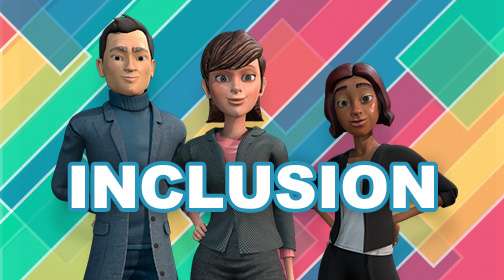
Inclusion · 1 h 30 min

Inclusion

Malta wants a more inclusive model. With Rianne and Kaiden, players investigate the biases, prejudices and stereotypes holding it back, their own included, and learn to recognise discriminatory behaviour.

  • English
  • Spanish
  • French
  • German
  • Portuguese
See Inclusion

Diversity · 1 h 35 min

Plural

Kaiden joins a firm that audits diversity for other companies and can’t manage its own. Players learn to recognise and respect diversity, promote it with everyday actions and lead inclusively.

  • English
  • Spanish
  • French
  • German
See Plural

Unconscious bias · 40 min

Together

Pablo walks players through his memories and sets an uncomfortable challenge: look inward. They analyse their own biases, recognise stereotypes and turn exclusionary attitudes into inclusive ones.

  • English
  • Spanish
  • French
See Together

Gender equality · 2 h

Idem

Alejandro is about to become CEO when he wakes up as a woman and starts noticing inequalities he had never seen. Players spot gender stereotypes, bias and microaggressions, and drive change through everyday actions.

  • English
  • Spanish
  • French
  • German
  • Portuguese
  • Italian
See Idem

Gender equality · 30 min

Inside

A short, documentary-style game built to reach the whole workforce quickly: recognise and challenge gender stereotypes and biases, identify discrimination and microaggressions against women at work, and act on them.

  • English
  • Spanish
  • French
  • German
See Inside

Sexual harassment prevention · 1 h 30 min

Safe

Follow Megan as she trains to become an auditor and finds the courage to share a secret of her own. Players learn to recognise sexual harassment in its different forms and the recommended steps for victims and witnesses.

  • English
  • Spanish
  • French
  • German
See Safe

EDI training and UK law: what employers should know

General information to help you scope a programme, not legal advice. Check the detail with your legal or HR advisers.

Who the Equality Act 2010 protects

The Act covers England, Scotland and Wales; only a few provisions reach Northern Ireland. Section 4 lists nine protected characteristics: age, disability, gender reassignment, marriage and civil partnership, pregnancy and maternity, race, religion or belief, sex and sexual orientation.

Why training matters when something goes wrong

Under section 109, anything an employee does in the course of their employment is treated as also done by the employer, whether or not the employer knew about it. The employer has a defence if it shows it took all reasonable steps to prevent it. In Acas’s guidance, training all workers on equality, diversity and discrimination is one example of those steps, and Acas recommends regular equality and diversity training and training line managers to recognise and address discrimination. For the manager side, see our line manager training.

Sexual harassment: a duty to prevent it since October 2024

Section 40A requires employers to take reasonable steps to prevent sexual harassment of their employees in the course of their employment. Safe can be part of your answer, alongside your policy and reporting routes, which it doesn’t replace.

What the evidence says about bias training

The review published on GOV.UK concluded that bias and diversity training does not seem to improve diversity outcomes on its own, and suggests that training works better as an ongoing process with several sessions and formats. That is why we treat unconscious bias training like Together as a first step, followed by courses where people practise inclusive decisions.

Sources (checked October 2026): Equality Act 2010, section 4, section 40A, section 109 and section 217 (legislation.gov.uk); Acas, vicarious liability and what an employer can do to prevent discrimination; GOV.UK, Unconscious bias and diversity training: what the evidence says (Behavioural Insights Team, 2020); Gino and Coffman, Unconscious Bias Training That Works, Harvard Business Review, 2021.

How it rolls out

  1. Before1

    Build the pathway

    With your Customer Success Manager you choose the courses, who plays which and by when.

  2. Launch2

    Plug it in

    From our campus or inside your LMS (Cornerstone, Moodle, SAP SuccessFactors…) through an integration or hybrid SCORM, with SSO or a QR code. On computer, tablet or phone.

  3. During3

    Staff play

    At their own pace, with feedback on every decision.

  4. After4

    See what moved

    Real-time progress per learner and group in the Admin module, Kirkpatrick-based reports and a certificate for everyone who finishes.

Real case, made in the UK

NHS Wales: 93% put the skills to work

We don’t have a published EDI case study yet, so here is a UK one on another soft skill: NHS Wales trained 30 staff in conflict resolution with Merchants, our negotiation simulator.

“Video games are an excellent learning tool.” Andrew Bunn, Training & Development Manager, NHS Wales.

You drive. Your CSM navigates.

Every project has a Customer Success Manager (CSM) who knows it inside out. They work with you to connect the goal you started with, what happens during the project and the results you get.

We don't just track progress. We help you decide what to do with what we learn.

Alwayswith a CSM by your side

StartYour goal

FinishYour results

  1. Defines success with you

    What you want to achieve, what should change and how we'll know it's happening.

  2. Gets your team on board

    Works with you to reach the participation you need and drive results.

  3. Measures what's changing

    Participation, progress, applicability and results. And, where the project allows, how your team is evolving.

  4. Spots where to act

    Flags risks before they put the result at stake, and opportunities to improve it.

  5. Turns results into decisions

    What we've achieved, what we've learned and what the next step should be.

One more lap: every review ends in a decision (keep going, improve or take the next step), always with someone who already knows your project.

EDI training: buyer questions

General information, not legal advice. Course details come from each course page in our catalogue.

Is EDI training mandatory in the UK?

The Equality Act 2010 doesn’t prescribe a specific course. But employers are liable for discrimination by staff at work unless they took all reasonable steps to prevent it, and Acas gives equality and diversity training as one example. Since October 2024 employers must also take reasonable steps to prevent sexual harassment. Your sector or regulator may add its own rules.

Is unconscious bias training effective?

On its own, not very. The review published by the UK government found it can raise awareness in the short term, but no evidence that it changes behaviour or workplace equality. We use Together as a starting point for self-reflection, then courses where people practise decisions and get feedback, inside a programme you measure.

Which course should we start with?

It depends on your goals. One option: Together or Inclusion for everyone, Plural for people who lead teams, Idem or Inside for gender equality and Safe for harassment prevention. Your Customer Success Manager helps you plan it.

How long are the courses?

From 30 minutes (Inside) to 2 hours (Idem); each course card above shows its duration. People play at their own pace, on computer, tablet or phone.

Which languages are available?

All six are in English. Most also come in Spanish, French and German, and some in Portuguese or Italian; each course card above lists its languages.

Will it work in our LMS?

Yes. Staff can play from the Game Strategies campus or from your LMS (Cornerstone, Moodle, SAP SuccessFactors and others) through an integration or hybrid SCORM, with single sign-on or a QR code.

How do we measure impact?

The Admin module gives you real-time progress and Kirkpatrick-based reports, from satisfaction to on-the-job application, using surveys built into every course. Read them next to your own EDI data, such as engagement surveys, to see whether things move.

Ready for EDI training people talk about for the right reasons?

Tell us who needs training and what you want to change. In a personalised demo we’ll show you the courses that fit and how they’d run in your LMS.