


More than 5000 satisfied customers worldwide













































What is corporate gamification?
Corporate gamification, also called gamification in the workplace, takes what hooks people in games (challenges, levels, leaderboards, rewards and instant feedback) and brings it to everyday work: training, onboarding new hires or chasing sales targets. If people want to play, they also want to learn, practice and get better.
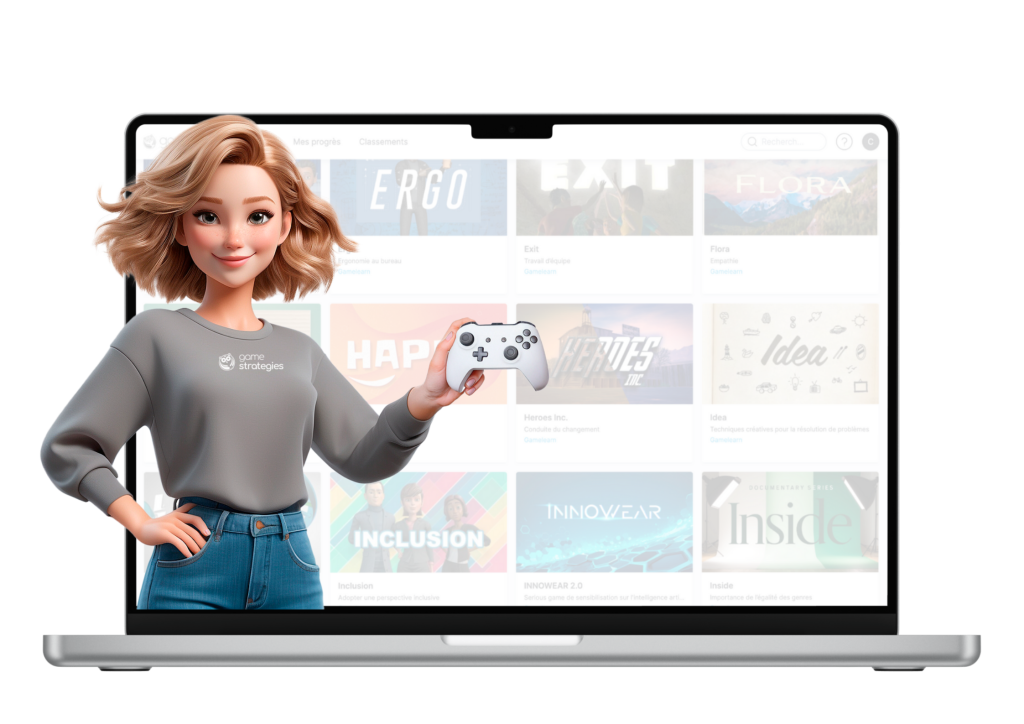
At Game Strategies we do it with game-based training simulations. Your people make decisions in realistic situations, see right away what worked and compete to climb the leaderboard. And you see in the reports who is making progress and what it does for the business.
We have been doing this for 20 years, with more than 5,000 clients. For the conversations that matter most, like handling an objection or a negotiation, there is AI Role Play: you talk to an AI avatar in real time and get feedback at the end. Want the bigger picture first? Read our guide to gamification in the workplace.

The benefits of gamification for companies
More engagement
Challenges, levels and leaderboards hook people in. At JTI, team motivation and engagement rose by 69%.
Goals everyone gets
When business goals become the game’s goals, everyone knows what they are playing for. With Kepler, real metrics decide who wins.
Learning by doing
In a simulation you decide, make mistakes with no real consequences and try again. What you learn reaches the job faster.
Instant feedback
Every decision gets an immediate response. Nobody has to wait for the annual review to know what to improve.
Training people finish
Gamified training gets completed: a 98% completion rate at Sareb and 99% at CaixaBank Consumer Finance.
Results you can measure
Kirkpatrick-based reports, from satisfaction to business impact. LG Spain measured a 12.61% productivity gain.
Where we apply gamification in your company
One area, one solution. Pick where you want to start.
- Training70+ game-based simulations for soft skills, sales and compliance, ready to play in up to 20 languages.
- OnboardingYour welcome program turned into a video game, with your culture, your processes and your content.
- SalesWith Kepler, your real sales targets power a strategy game. And to practice calls, there is AI Role Play.
- Customer serviceIn 2100, your team practices 27 real customer situations, without any real angry customers.
- LeadershipYour managers learn to motivate, delegate and give feedback by making decisions in realistic situations, with Pacific.
- HR and L&DFrom day one to the next promotion: onboarding, training and development, with data you can take to leadership.
Real results
Corporate gamification examples
Four companies, four different goals and the same way of reaching them: by playing. These figures come from their case studies.
- +69%motivation and engagement at JTI, with 50+ serious games for 1,200 employees in 76 countriesRead the JTI case study
- +40%new business acquisition per year at CaixaBank Consumer Finance, after negotiation training with MerchantsRead the CaixaBank case study
- −27%staff turnover at Sareb, which trained its people with four games from our catalogRead the Sareb case study
- −63%training cost per employee at MAN Truck & Bus Iberia, compared with other solutions, mostly classroom-basedRead the MAN case study
Sareb: turnover from 9.9% in 2015 to 7.2% in 2017. Figures published in each company’s case study.
How to roll out gamification in your company in 5 steps
- 1
Pick a business goal
More engagement, more sales, lower turnover… With your Customer Success Manager you decide what should change and how you will measure it, before you start.
- 2
Choose the right mechanic
Catalog simulations for skills, gamified onboarding for new hires, Kepler for sales targets and AI Role Play to practice conversations.
- 3
Plug it in, hassle-free
From our campus or your LMS (through an integration or hybrid SCORM), with SSO or a QR code, on computer, tablet or phone, in up to 20 languages.
- 4
Launch it like a premiere
Communication matters. CaixaBank Consumer Finance launched Merchants with a campaign and a trailer, and 99% of its team finished the course.
- 5
Measure, adjust, play again
The Admin module gives you Kirkpatrick-based reports, and every learner gets a certificate on completion. With that data, you plan the next round.

In their own words
Playing is undoubtedly a key way to involve employees, regardless of their age. We are all players at heart.
Competing and playing bring out the best in you. And by bringing out the best in you, you assimilate the information better and then you use it in your day-to-day work.
Games leave a lasting impression—even more than classroom training. Employees themselves tell us they remember things better in this fun and unique environment.
You drive. Your CSM navigates.
Every project has a Customer Success Manager (CSM) who knows it inside out. They work with you to connect the goal you started with, what happens during the project and the results you get.
We don't just track progress. We help you decide what to do with what we learn.
Alwayswith a CSM by your side
StartYour goal
FinishYour results
Defines success with you
What you want to achieve, what should change and how we'll know it's happening.
Gets your team on board
Works with you to reach the participation you need and drive results.
Measures what's changing
Participation, progress, applicability and results. And, where the project allows, how your team is evolving.
Spots where to act
Flags risks before they put the result at stake, and opportunities to improve it.
Turns results into decisions
What we've achieved, what we've learned and what the next step should be.
One more lap: every review ends in a decision (keep going, improve or take the next step), always with someone who already knows your project.
Corporate gamification FAQ
What is corporate gamification?
It means applying game mechanics (challenges, levels, leaderboards, rewards and instant feedback) to work processes such as training, onboarding or sales targets. At Game Strategies we do it with game-based training simulations: your team learns by making decisions in realistic situations.
What are the benefits of gamification in the workplace?
More engagement, training people actually finish and results you can measure. A few published examples: JTI raised team motivation and engagement by 69%, LG Spain increased productivity by 12.61% and Sareb cut staff turnover by 27%.
Which areas of a company can you gamify?
Soft skills, sales and compliance training with our catalog; new hire onboarding with gamified onboarding; sales with Kepler and AI Role Play; customer service with 2100; and leadership development with games like Pacific.
What is the difference between gamification and serious games?
Gamification adds game mechanics to something that is not a game, like a sales leaderboard. A serious game is a video game designed for learning. We combine both: game-based training simulations, with leaderboards, levels and challenges around them.
How do you measure the impact?
With the Admin module, which provides reports based on the Kirkpatrick model: from satisfaction and learning to on-the-job application and business results. Your Customer Success Manager helps you decide what to measure from the start.
Does it integrate with our LMS?
Yes. People play from our campus or from your LMS, through an integration or hybrid SCORM, with SSO and QR code access. It works on computer, tablet or phone, in up to 20 languages.
Do you build custom games?
No. We work with a catalog of 70+ ready-to-play training simulations. What we do tailor to your company is onboarding, with your own content, and AI Role Play scenarios, with your product and your customers.
Ready to play with your team?
Tell us what you want to move (training, onboarding, sales or your leaders) and we will show you in a personalized demo which catalog games, challenges and onboarding fit your team.