

What's inside
- 01Traditional e-learning no longer works
The completion and satisfaction data that explain why online courses fail to hook people.
- 02Ready for the new generations?
What millennials expect from training and why it clashes with mass e-learning.
- 03Training vs. lack of motivation
What happens when a team is disengaged, and the role training can play.
- 04An incalculable cost
Why paying less for courses nobody finishes ends up costing a fortune.
- 05Strategies 1–3: research, find and validate
Getting to know your employees and using that to filter the best solutions on the market.
- 06Strategies 4–6: quality, practical, applicable content
The questions any course should pass before it makes it into your offer.
- 07Strategies 7–10: formats, methods and tools
From e-reading to interactive formats, and from LMS as a warehouse to LMS as a CRM.
- 08Strategies 11–14: risk-free practice
Safe environments, simulators, good design and experiential learning with the 70:20:10 model.
- 09Strategies 15–18: feedback, freedom and soft skills
How to give useful feedback, let people set their own pace and link training to their success.
- 10Strategies 19–22: challenges, adventure and community
Gamification and shared experiences so your program feeds on word of mouth.
- 11Strategies 23–27: sell, involve and earn credibility
Your department as a marketing team, leadership buy-in and the reputation of L&D.
- 12Strategies 28–30: play
Why video games are the most powerful tool on the list and how they close the loop.
What's killing learner engagement in online training?
The starting numbers in the guide sting: traditional online training has a 30% completion rate, and users rate it 2.5 out of 10. In money terms, 3 out of every 4 euros you invest end up in the bin.
This isn't just an L&D headache. In Deloitte's Global Human Capital Trends 2015, more than 3,300 HR and L&D leaders from 106 countries named engagement as their biggest challenge for the years ahead. And according to Gallup, over 70% of US workers didn't feel motivated at work.
The guide's argument is simple: the format isn't the problem, what you put inside it is. Courses that are nothing but reading (e-learning turned into e-reading), endless catalogs and scattered micro-lessons with no common thread. The good news: all of that is in your hands.
Start with your people, not your catalog
The first strategies are about doing your homework. Before you launch anything, find out what your people need, what they aim for and what really drives them. Then search, assess and validate the best solutions out there. Nobody should have to dig through thousands of courses alone: the internet already gives them free content, sometimes better than what's in your LMS.
Rethink your platform too: stop using your LMS as a content warehouse and treat it like a CRM. Watch how learners behave, listen to their feedback and keep improving what you offer.
The final filter is quality, no excuses. Less variety beats one bad course, because a weak course drags down the reputation of your whole offer. The guide suggests four questions before giving any course the green light:
- Does it show a real benefit for the learner?
- Does it give people tools they can use on the job?
- Can they practice the skill without risk?
- Is it what your people actually need?
Risk-free practice, feedback and freedom
The heart of the guide is learning by doing. It builds on Lombardo and Eichinger's 70:20:10 model: 70% of what we learn comes from experience, 20% from watching others and just 10% from courses and reading. If your training lives in that 10%, you're playing with one hand tied behind your back.
That's why simulators take center stage: realistic situations where mistakes cost nothing and seeing the outcome of each decision teaches more than any slide deck. Add personalized, ongoing feedback (about facts, not people), polished design and the freedom to learn when, where and on whatever device each person prefers.
And what should you train? Soft skills. The guide includes the list of top skills for 2020 presented at the World Economic Forum in Davos, led by complex problem solving, critical thinking and creativity. They're hard to hire for, so you're better off developing them in-house.
Learning occurs when someone wants to learn.
Challenges, community and a bit of marketing
This is where gamification comes in: leaderboards, challenges, badges and levels that turn learning into a personal goal or a team competition. The guide goes a step further and suggests building an adventure, with video games, simulators and mobile learning, so the course stops being a string of readings and quizzes.
Then comes the part many teams forget: selling it. Run L&D like a marketing team, with campaigns, emails, video and promotions. Build a community so word of mouth does part of the work. Get leadership involved (taking the training, not just signing off on it) and recognize your own team, because a motivated L&D team picks better content.
The payoff is credibility. When people see that training actually helps their career, they come back to the platform without anyone chasing them.
What if your training were a video game?
The last strategies boil down to one verb: play. The guide cites Traci Sitzmann's meta-analysis of simulation games, which found 20% higher learner confidence and 11% higher conceptual knowledge compared with traditional training.
That's the bet Game Strategies (formerly Gamelearn) has made: training video games that combine quality content, simulators with feedback and gamification techniques such as storytelling. According to the guide, they reached completion rates above 90% with more than 100,000 learners. And if you'd rather not start from scratch, the Game Strategies catalog already has ready-to-play games on leadership, communication and productivity.
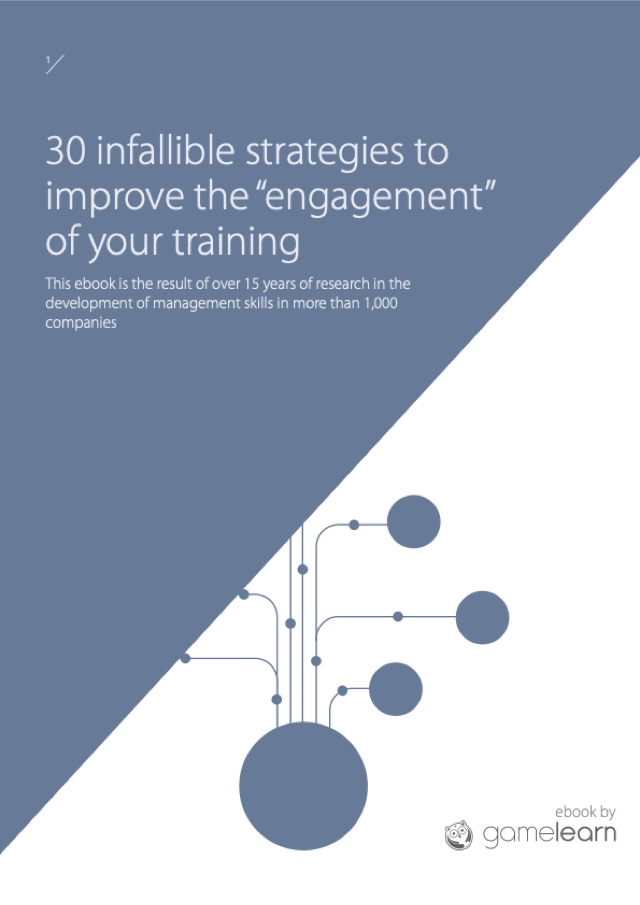
The PDF walks you through all 30 strategies, with checklist questions, examples and references. Download it and pick the one you'll start with on Monday.
FAQ
What is learner engagement?
It's how involved your people are with training: whether they start, finish, apply what they learned and come back for more. Low engagement shows up as poor completion rates and courses nobody recommends.
Why don't employees finish online courses?
According to the guide, because many courses are just reading and quizzes with no practice, don't feel useful for the job and sit in huge catalogs with no guidance. Content quality and relevance matter more than the format.
How do you measure engagement in a training program?
The basics are completion rate, participant ratings and voluntary return visits to the platform. The guide also suggests treating your LMS like a CRM: analyze behavior and collect feedback to keep improving your offer.
Is gamification enough to engage learners?
No. Leaderboards, challenges, badges and levels help people get started, but without quality, practical, applicable content the effect fades fast. The guide recommends combining solid content, simulation with feedback and gamification.
Is the guide free?
Yes. You can download the PDF for free in English, Spanish or French.