

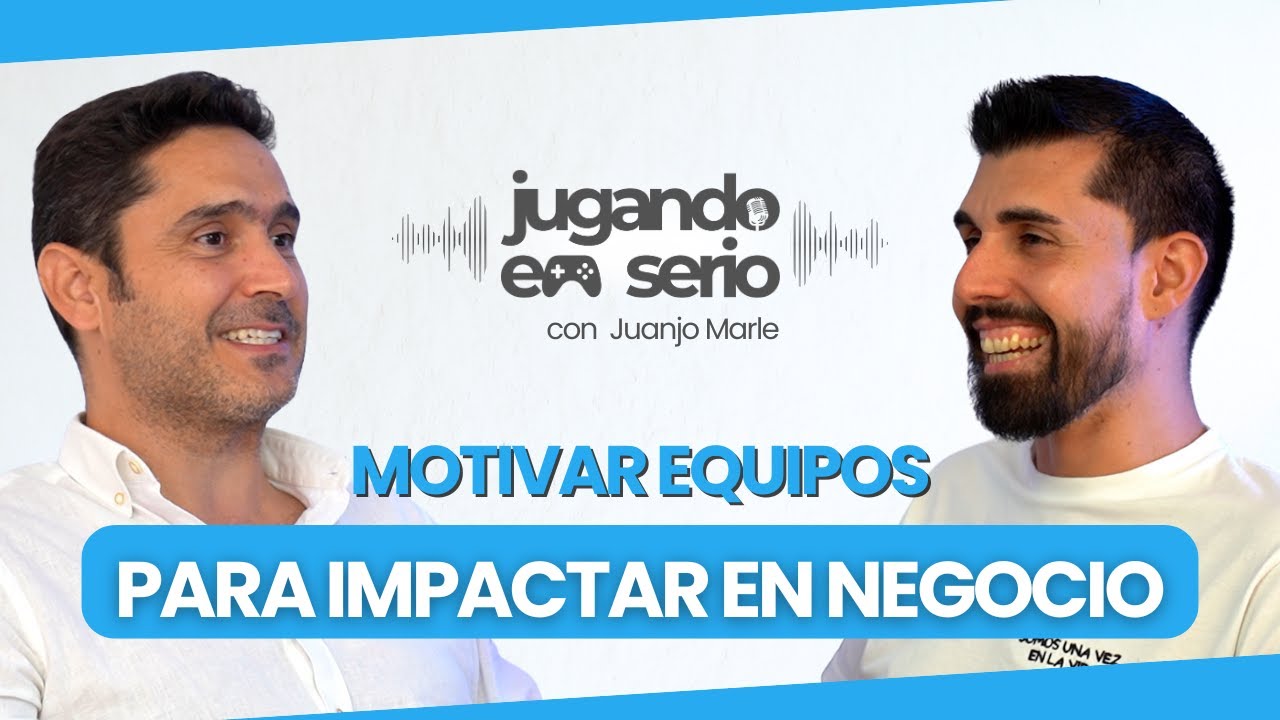
Many companies keep launching courses and digital campuses while behaviors don't change and the business barely notices. In this episode of Jugando en Serio (in Spanish), Juanjo Marle, an expert in cultural transformation, values-based hiring and leadership, explains how to build a learning culture that goes beyond one-off initiatives and connects people, purpose and the bottom line.
Lifestyle first, then the job
Marle calls himself «an educational failure»: he piled up degrees and master's programs only to end up doing something else, because he was studying but not learning. He found his place in HR, with a clear purpose: helping people land a job where they can shine.
That's why, before talking about career purpose, he asks what lifestyle you want. If you dream of saving lives as a doctor while traveling the world, sooner or later you'll have to choose. And if you want to be a footballer at 47, the key is to find out why: maybe what drives you is football itself, and there are many paths around it. When your personal and professional paths line up, the circles come together.
Hiring for values isn't enough if you don't manage by values
Marle distinguishes between an eligible candidate, who has the technical knowledge, and a suitable one, who also fits the environment. Give someone a 17-step roadmap and they'll ask for help at the first obstacle; ask them to be honest, transparent and eager to learn, let them choose how to get from A to B, and you can trust them to get there.
He also argues for hiring for the result you need, not the job title. His example: the best SDRs are the people collecting signatures for NGOs on the street in the middle of winter, because they already have drive and tolerance for frustration.
It's great that I can hire for values, but if you don't manage by values within the culture, it's useless. The culture and the managers have to support it.
How to build a learning culture: purpose, expectations and emotion
Today, 60-year-old professionals raised on a more authoritarian leadership style work alongside a Generation Z that won't tolerate certain things, and for Marle that coexistence is the main battleground. Training is no exception, although there the desire to learn depends more on the person than on age.
The starting point is knowing what the training is for. Some companies train just to use up their training credits. If training doesn't solve a real need, there's nothing to be done. Then come expectations: many companies hit their sales KPI and still lose their best salespeople because nobody made them feel part of the team. And finally emotion, which Marle calls «the glue of memory»: without it, what you learn never gets applied.
KPIs are often met, those little numbers we fight for from January 1st to December, but if expectations aren't met, that's when the problems start.
AI and play to personalize learning
Marle is a fan of play as a tool: he would love to run hiring processes using only video games, because watching someone play reveals more than a panel discussion, and methods like Lego Serious Play already take advantage of this. But what he sees changing the rules is artificial intelligence, which he uses in recruitment, team management and executive coaching.
Technology used to help you go faster; now it delivers results tailored to your case and context. If you're learning a language, AI adapts to your pace and covers the topics you enjoy. That's why, he says, there are no excuses anymore: AI is changing the rules of the game in innovation and training.
Change without seeing the whole staircase
His own life is a case study in change: two years ago he became a digital nomad, first around Spain and then to countries like Japan, Thailand and Egypt. Not everything that glitters is gold, since he travels to work, not on vacation, but he feels he has found a way to stretch time. The trigger was LinkedIn: for him, a personal brand means putting your talent behind a loudspeaker.
And if you know you need to change but don't? Maybe it doesn't hurt enough yet. According to Marle, we all know the next step, even if we can't see the whole staircase: if you want to build your personal brand, record a video, even if you delete it afterwards.


