

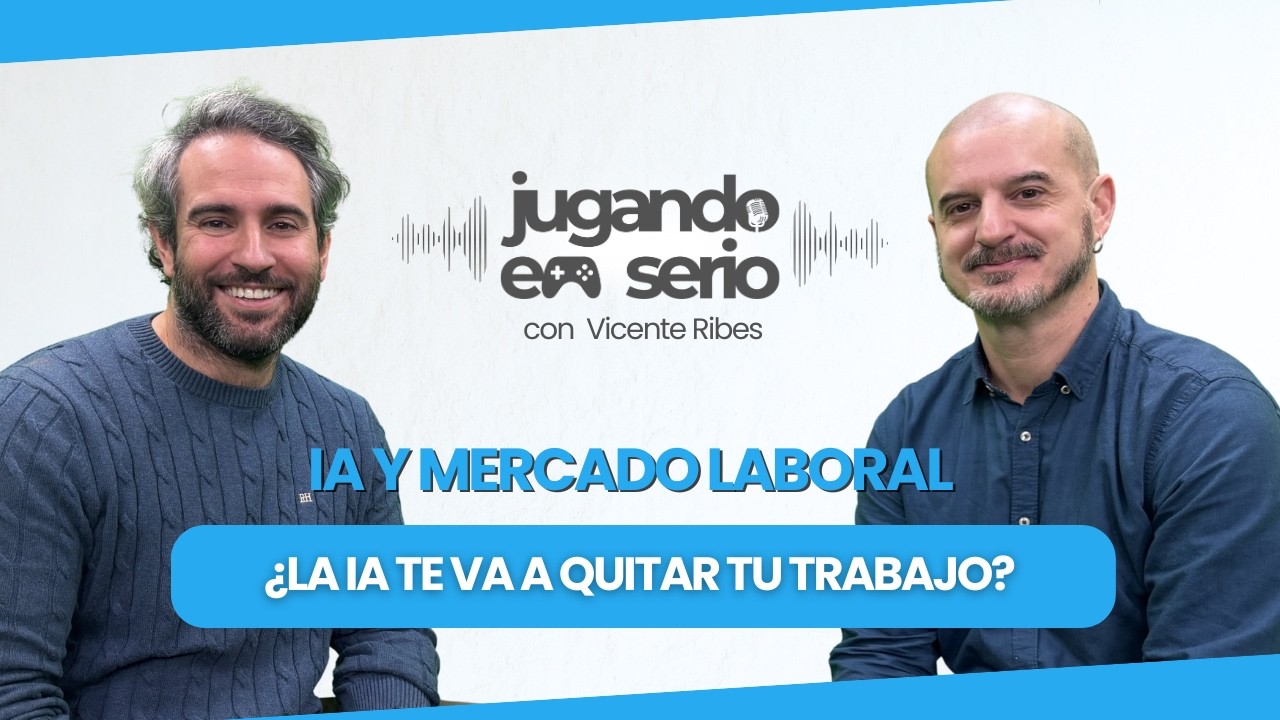
Companies say they can't find talent, yet there are more qualified professionals than ever. Is talent really scarce, or are we still measuring it with rules that artificial intelligence has made obsolete? In this episode of Jugando en Serio (in Spanish), Vicente Ribes Muñoz, a consultant specializing in AI and HR, explains how AI is reshaping the job market and what companies and professionals can do to adapt.
AI and the job market: the rules of the game have changed
For Ribes, we're living through a revolution comparable to the industrial one, only much faster. He started working with AI three years ago, when ChatGPT arrived, and today he's considered an expert. That's the new paradigm: in a field that changes every few months, asking for 10 or 15 years of experience no longer makes sense, and professionals have to keep adapting.
Degrees are losing their value as a guarantee, too. According to Ribes, a university degree no longer secures a job unless you keep learning, while vocational training and trades such as plumbing or carpentry, which AI can't replace, are gaining ground.
Adaptability, the human side and the death of the CV
If AI takes over technical and repetitive work, the human side becomes more valuable. The first skill Ribes points to is continuous adaptation to change; the second is the human side: our emotions and the way we relate to others. He also expects fewer jobs for life and more freelancing, self-employment and project-based work.
The paper CV, meanwhile, is dying. With applicant tracking systems, anyone can learn which keywords get through the filter, and a recruiter may receive a thousand applications for a single opening. Candidates will have to sell themselves like a product, with a clear value proposition, and the face-to-face interview is once again where everything is at stake.
From retaining talent to earning its loyalty, starting with the job ad
Ribes doesn't talk about retaining talent («it sounds like chains to me») but about earning its loyalty. If AI handles tasks such as CV screening, HR can focus on people. And onboarding starts when the job ad is published, which is already employer branding, and continues with details like a buddy during the first weeks.
That's why he criticizes one-size-fits-all job ads: lists of requirements, free fruit and even the «unicorn» with 15 years of AI experience. What attracts people is explaining the day-to-day, the career path and the culture. And the talent you let go, he warns, takes everything you gave it to your competitors.
How am I going to join your company if you're telling me you have good coffee or free fruit? Offer me a career where I can grow. Move my heart, move my mind a little, so that I want to come with you.
How to roll out AI in a company without failing
The first step, Ribes says, is the why: implementing AI «because it's trendy» doesn't work; you have to start from a real problem. Then comes communication. If a virtual assistant arrives without anyone talking to the staff, people fear losing their jobs. The answer is a reskilling plan: measure each person's skills and move them, for example, from administrative tasks to talent development.
His method is pilot projects, such as a 24/7 assistant that handles employees' questions about holidays, collective agreements or leave. You measure it and, if it works, extend it through micro-projects to other areas, with managers in charge of passing the message on to their teams.
Working with machines and losing your fear of AI
Ribes foresees hybrid human-machine workplaces, where managers will decide what the team does and what the assistants do, and will oversee their work. He admits some people will be pushed out of the job market, but new professions will also appear, as happened with the community manager.
His recipe for a change of mindset is to start using it: in his training sessions he sees people aged 50 or 55 adapt without difficulty. He reinvented himself three years ago, when he felt stuck in his career.
The trick is to lose your fear of it, because it really is just talking. What you do is have a conversation with a machine, tell it things and ask it to do tasks.