


In this article
- What is a game-based learning provider?
- The types of game-based learning providers
- 1. Off-the-shelf serious game catalogs
- 2. Custom game studios
- 3. Gamification and quiz platforms
- 4. Authoring tools with game features
- 5. AI conversation simulators
- How to choose a game-based learning provider: an 8-point checklist
- Game-based learning providers worth knowing
- Game Strategies
- Attensi
- Designing Digitally
- Mursion
- Gamification platforms and authoring tools
- Game-based learning providers compared
- Questions to ask in a game-based learning demo
- When game-based learning is not the right fit
- Frequently asked questions
A game-based learning provider is a company that teaches workplace skills through games and simulations, and the right one depends on a question most buyers skip: do you want ready-made games your people can start next week, a studio that builds a game around your own process, or a tool to make games yourself? Those are three different purchases, with different budgets, timelines and risks, and most lists of "game-based learning companies" mix them all together.
This guide explains the types of game-based learning providers, gives you a checklist to compare them, and puts the best-known names side by side in one table. It also covers the questions to ask in a demo and the cases where game-based learning is simply the wrong tool. Full disclosure: Game Strategies is one of the providers on the list. We sell an off-the-shelf catalog of training simulations, we do not build custom games, and we say so wherever it matters.
What is a game-based learning provider?
A game-based learning provider supplies training in which the game is the learning experience itself. Employees step into a story, make decisions, see the consequences and get feedback, much like a flight simulator for leadership, sales or customer service. That is different from gamification, where points, badges or leaderboards are added on top of regular content. If you want the theory first, read what game-based learning is and the 4 key differences between gamification and serious gaming.
Companies turn to these providers for a practical reason. Plenty of online training gets started and abandoned, and even when people finish a course, reading about a tough conversation does not prepare them to have one. A good game gives people a safe place to practice, fail and try again before it counts.
The types of game-based learning providers
When you search for game-based learning providers or game training providers, you get four very different kinds of company, plus a newer fifth one. Knowing which kind you need narrows the shortlist fast.
1. Off-the-shelf serious game catalogs
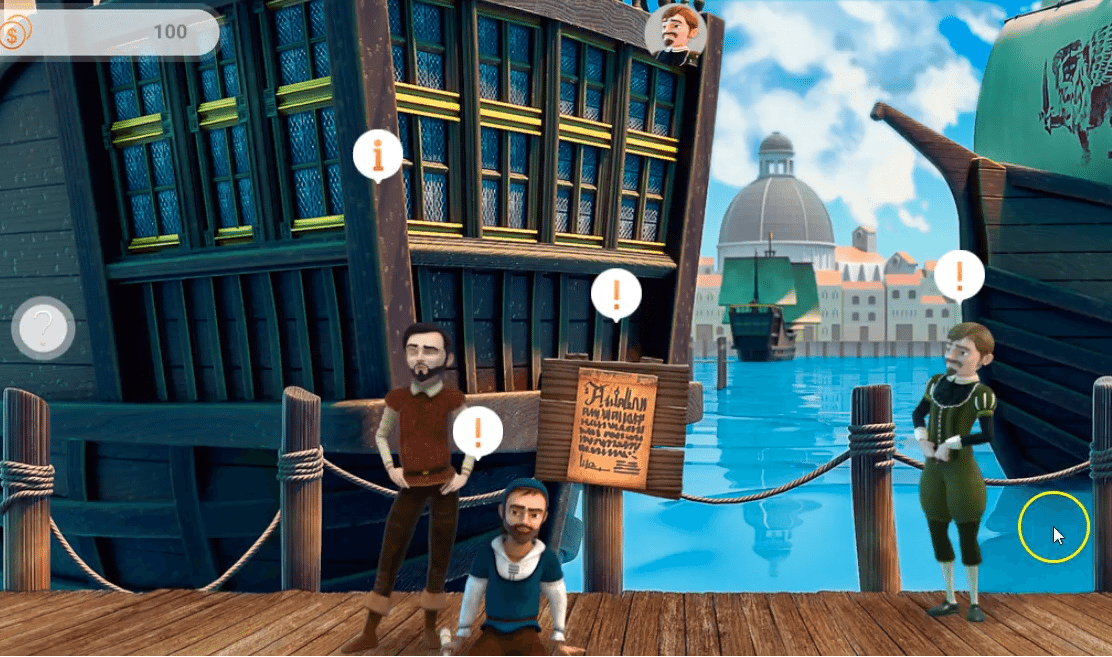
A library of ready-made games or simulations on skills almost every company needs: leadership, negotiation, communication, customer service, productivity, compliance. You license access, roll it out and track results. This is what Game Strategies does: 70+ courses built as video games that work as simulators, in up to 20 languages.
- A good fit if you need transferable skills for many people and want to launch in weeks, not months.
- Keep in mind that the content is the same for every client. If you need a game about your own internal procedure or product, a catalog will not give you that.
2. Custom game studios
Studios that design and build a game or simulation for your company, around your processes, products and brand. Examples include Designing Digitally, which describes itself as a developer of custom training games, eLearning and VR, and Attensi, which builds realistic practice scenarios tailored to each client's workflows and offers AI authoring tools.
- A good fit if the thing you need to teach is specific to your business: a machine, a store routine, a proprietary sales method.
- Keep in mind that custom work is a project with discovery, design, production and testing phases. Ask about timelines and who maintains the game when your process changes.
3. Gamification and quiz platforms
Software that turns your content into quizzes, challenges and competitions, such as Kahoot! 360, Atrivity or Centrical. Strictly speaking they are gamification rather than game-based learning, but they show up in the same searches. We compare them in depth in our guide to the best gamified learning platforms.
- A good fit if you need to reinforce knowledge (product facts, policies, procedures) or energize a team around targets.
- Keep in mind that you supply the content, and getting a question right is not the same as handling the situation at work.
4. Authoring tools with game features
Tools your own team uses to build interactive courses, branching scenarios and simple games. Articulate Storyline 360 is the best known for interactive courses and branching scenarios; Genially offers templates for games, quizzes and escape rooms; iSpring Suite builds courses from PowerPoint; and isEazy combines an authoring tool with an LMS.
- A good fit if you have an instructional design team with time to build and maintain content.
- Keep in mind that the tool is only half the job. The quality of the game depends entirely on whoever designs it.
5. AI conversation simulators
The newest family. Learners talk to an AI character, in real time, and get feedback on how they handled the conversation. Mursion positions itself as an immersive learning platform with AI-powered simulations and avatars for difficult conversations, leadership and customer care. Our own AI Role Play works the same way for sales and management conversations, with scenarios adapted to your context and feedback at the end.
- A good fit if the skill you need is conversational: discovery calls, objections, performance reviews.
- Keep in mind that it complements broader skills training rather than replacing it.
How to choose a game-based learning provider: an 8-point checklist
Once you know which type you need, use these criteria to compare game-based learning companies on equal terms.
- Catalog breadth, or production capacity. For a catalog: how many titles, on which skills, and how often new ones come out. For a studio: how many projects like yours they have delivered, and can you see one.
- Languages. If your teams sit in several countries, check that the game is fully localized (voice, text, cultural references), not just subtitled. Ask for the exact list of languages per title.
- LMS, SCORM and SSO. Can it run inside your LMS, through an integration or a SCORM package? Does it support single sign-on? Is there a standalone portal if you don't have an LMS? If SCORM is new to you, start with what SCORM is.
- Reporting. Completions are the floor, not the goal. Ask what the reports show about decisions, scores and progress, and whether they map to the Kirkpatrick model (reaction, learning, behavior, results). Our article on KPIs to measure training impact covers how to do this.
- Mobile. Frontline and field teams rarely sit at a desk. Check that the full game works on a phone or tablet, not a reduced version.
- Pricing model. Per user, per bundle of licenses, per title or per project. Few providers publish prices, so ask for a quote with your real headcount and check what's included: implementation, support, reporting and new titles.
- Support. Will someone help you plan the launch, communicate it and read the data afterward? A game nobody promotes gets played once.
- Proof. Ask for case studies from companies like yours, awards that can be verified, and a pilot with your own employees before you sign a long contract.
Game-based learning providers worth knowing
Game Strategies
An off-the-shelf catalog of 70+ soft skills, sales and compliance courses built as video games that work as simulators, in up to 20 languages, with more than 5,000 clients over 20 years building on the Gamelearn legacy. Examples: Merchants for negotiation, Pacific for leadership, 2100 for customer service and Kaos for conflict resolution.
- Access: from our campus, from your LMS (integration or hybrid SCORM), with single sign-on or a QR code, on desktop, tablet or phone.
- Measurement: an Admin module with reports based on the Kirkpatrick model, a certificate on completion and a Customer Success Manager for every project.
- Also: AI Role Play for conversation practice and gamified onboarding adapted with your own content.
- Keep in mind that we do not build custom games or e-learning. If you need a game about your own process, a custom studio is the right call.
Attensi
Practice-based training with realistic, role-based scenarios tailored to each company's brand and workflows, plus AI authoring tools. Its site lists industries such as hospitality, retail, energy, pharma, financial services and healthcare. A fit when you want realistic simulations of your own routines and are ready for a tailored project.
Designing Digitally
A custom training developer that builds employee training games, eLearning and VR experiences. A fit when you want an external team to design a game from scratch around your content.
Mursion
An immersive learning platform with AI-powered simulations, where learners practice with avatars that push back and get personalized feedback. Aimed at enterprise L&D teams working on leadership, difficult conversations, customer care and sales.
Gamification platforms and authoring tools
Kahoot! 360 (live quizzes for sessions and events), Atrivity (one-minute mobile challenges for product-heavy sales teams) and Centrical (performance, gamification and coaching for contact centers) are covered in our gamified learning platforms comparison. On the authoring side, Articulate Storyline 360, Genially, iSpring Suite and isEazy let your team build its own interactive content.
Game-based learning providers compared
2027 comparison
Game-based learning providers at a glance
Public information from each provider, checked in October 2026. Confirm it in a demo.
| Provider | Type | Who builds the content | Best for |
|---|---|---|---|
| Game StrategiesRecommended70+ simulationsUp to 20 languagesLMS, SCORM and SSO | Off-the-shelf catalog | Ready to use, from our catalog | Soft skills, sales and compliance that need practice |
| Attensi | Tailored simulations | Tailored to your workflows, with AI authoring tools | Company-specific routines in service industries |
| Designing Digitally | Custom studio | Their team, built for you | Custom games, eLearning and VR |
| Mursion | AI simulations | Simulations on their platform | Difficult conversations and leadership |
| Kahoot! 360 | Quiz platform | You | Live sessions, meetings and events |
| Atrivity | Microlearning | You, with AI-generated questions | Product knowledge in sales teams |
| Centrical | Performance + learning | You, on their platform | Large contact centers |
| Articulate Storyline 360 | Authoring tool | Your instructional designers | Interactive courses and branching scenarios |
| Genially | Authoring tool | Your team, from templates | Quick games, quizzes and escape rooms |
| iSpring Suite | Authoring tool | Your team, in PowerPoint | Teams that already work in PowerPoint |
Want game-based training your people can start next week? 70+ simulations, ready to launch.
See the catalog →Questions to ask in a game-based learning demo
A demo is designed to impress. These questions bring it back to what you will actually live with:
- "Can I play a full module, not just the trailer?" Ten minutes of real gameplay tells you more than any slide.
- "What does a learner do in the first five minutes?" If the answer is "watch a video," it may be a course with a game skin.
- "How does the game give feedback on a bad decision?" Good simulations show consequences and explain why.
- "How long does a full course take, and can people stop and resume?" It has to fit around real work.
- "Show me the admin reports with real data." Ask what you can see per person, per team and per skill, and how it connects to on-the-job results.
- "How does it run in our LMS, and with SSO?" Get IT on this call, not after the contract.
- "Which languages are fully localized for the titles we want?" Check title by title.
- "Who helps us launch it, and what happens after month one?" Ask for the name of the role, not "our team."
- "Can we run a pilot with 20 to 50 employees first?" Watch two numbers: how many finish and what they say they will apply.
For a custom studio, add: who owns the source files, how changes are handled after launch, and what the timeline looks like from kickoff to rollout.
When game-based learning is not the right fit
We sell games, and we will still tell you when not to buy one:
- Pure information transfer. If people only need to know a new policy or a product update, a short document, a video or a quiz is faster and cheaper.
- Hands-on technical skills. Operating heavy machinery or performing a clinical procedure needs physical practice or specialized simulators, not a soft skills game.
- A process unique to your company. An off-the-shelf catalog, ours included, will not teach your internal tool. That is a job for your own team with an authoring tool or for a custom studio.
- No time to play. If employees have no protected time for training at all, no format will fix it. Solve the time problem first.
- A motivation problem, not a skills problem. If your team knows what to do but isn't doing it, look at incentives. For sales, that is what Kepler is for.
When the goal is to change how people lead, sell, negotiate or serve customers, practice wins, and that is where game-based learning earns its place. Our guide to training simulations for employees goes deeper into the format, and if you are still deciding between a platform and content, read LMS vs content library.
Frequently asked questions
What do game-based learning providers do?
They supply training in which employees learn by playing: they make decisions in a realistic story and see the consequences. Some sell ready-made catalogs, some build custom games for each client, and some sell the tools to build games yourself.
What is the difference between game-based learning companies and gamification platforms?
Game-based learning companies use a full game or simulation to teach. Gamification platforms add game elements such as points, leaderboards and challenges to your own content or to sales targets. Both can work, but they solve different problems.
Does Game Strategies build custom games?
No. We offer a catalog of 70+ ready-made training simulations, plus AI Role Play scenarios and gamified onboarding adapted with your content. If you need a game built around your own process, look for a custom game studio.
How much does game-based learning cost?
It depends on the model. Catalogs usually charge per user or per bundle of licenses, custom studios charge per project, and authoring tools charge per author seat. Few providers publish prices, so ask for a quote based on your headcount.
Can game-based training run inside our LMS?
Usually, yes. Game Strategies simulations run from your LMS through integration or hybrid SCORM, with single sign-on, or from our own campus. More details in our gamified training FAQ.
How do I measure whether game-based learning works?
Go beyond completion rates. Track learner reaction, in-game performance, behavior on the job and business indicators, following the Kirkpatrick model, and compare against a group that did not take part when you can.
Sources: public websites of each provider, checked in October 2026: attensi.com, designingdigitally.com, mursion.com, articulate.com, genially.com, plus Kahoot!, Atrivity, Centrical, iSpring and isEazy. Offers change, so confirm them in a demo with each provider.