


What the report reveals
- Digital training budgets keep growing
In the 2021 edition, 60% of HR professionals said they had increased their online training budget. In 2022, the share of companies investing grew.
- Employees barely give it a pass
They rate the digital training they receive at 6 out of 10 on average: an NPS of -29.
- The complaint hasn't changed
In 2021, the top drawbacks were that it was boring and not very interactive. A year later, the same criticism remains.
- They want simulation and gamification
Overwhelmingly, employees want real-life simulations and gamification in their online courses.
- HR and consultants agree
For the second year running, HR professionals and consultants believe these ingredients belong in their courses.
- More courses built in-house
Companies created more online courses internally in 2021, and external instructional design consultants still play an important role.
- Budget isn't the bottleneck
The money is there. The report points to other brakes: convincing management and the belief that innovation means complicated processes.
- Video games as the bridge
Quality content, a story, gamification and simulations with instant feedback: the game-based learning recipe for closing the gap.
What is the Contradictions of Corporate Training 2022 report?
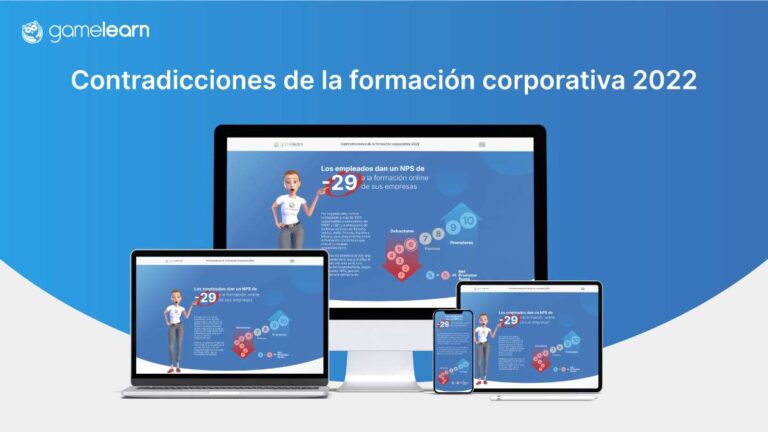
It's the second edition of the survey Gamelearn (now Game Strategies) uses to compare the training companies offer with what their employees expect. By April 2022 it was available in a web format, with responses from more than a thousand employees and HR and L&D professionals, plus consultants from the field.
Because there was already a 2021 edition, this report lets you do something really useful: see what changed in a year. And, above all, what didn't.
An online training NPS of -29: what does it mean?
On a scale of 1 to 10, employees give the digital training they receive from their company an average score of 6. Apply the Net Promoter Score formula and that translates into an NPS of -29.
NPS subtracts the percentage of detractors from the percentage of promoters. Anyone who scores 6 counts as a detractor, so a negative result means something very simple: more people would advise against your courses than would recommend them.
Surprising? Not really. The figure is in line with the scores e-learning has always received, held back by monotonous, non-interactive formats. But just because it's normal doesn't make it acceptable.
More e-learning investment, same complaint
Money isn't the problem. In the 2021 edition, 60% of HR professionals said their company had increased its online training budget. In 2022, the share of companies investing in digital training didn't drop. It went up.
Companies also created more online courses in-house in 2021 than the year before, and external instructional design consultants remain an important source of support. More courses, more budget… and the same level of satisfaction.
Because the underlying complaint hasn't changed. In 2021, the two drawbacks employees mentioned most were that online training was boring and not very interactive. A year later, that criticism was still there.
Simulation and gamification: everyone wants the same thing
Here's the contradiction. Overwhelmingly, employees say they'd like to find real-life simulations and gamification in their online courses. And, for the second year running, HR professionals and consultants think exactly the same.
So if there's agreement and there's budget, what's going wrong? The report points to two brakes: it's still hard to convince management, and innovation is wrongly associated with new, complicated processes.
Game-based learning busts that myth with a simple recipe:
- Quality theoretical content.
- A story that hooks people.
- Gamification elements.
- Simulations with instant feedback, so people learn by doing.
How to raise your online training NPS
The data is from 2022, but it's still a useful starting point. A few ideas to push your score up:
Want to see where all this started? The 2021 edition of the report shows how online training became boring right when it was being used the most.
- Measure the NPS of every course, not just whether it was completed.
- Always add an open question: the why is worth more than the number.
- Swap some video and PDF for practice: simulations where mistakes cost nothing.
- Get people practicing tough conversations: with AI Role Play, your team talks in real time with an AI avatar and gets feedback when the conversation ends.
- Start with a pilot and take the results to management: it's the fastest way to unlock change.
FAQ
What is training NPS?
It's the Net Promoter Score applied to a course: it measures how many participants would recommend it versus how many wouldn't. You calculate it by subtracting the percentage of detractors from the percentage of promoters. A negative score means detractors outnumber promoters.
How do employees rate their online training?
According to the Contradictions of Corporate Training 2022 report, 6 out of 10 on average, which is equivalent to an NPS of -29.
Who took part in the 2022 report?
More than a thousand employees and HR and L&D professionals, plus consultants from the field. It's the second edition of the report, following the 2021 one.
What do employees want in their online courses?
Overwhelmingly, real-life simulations and gamification. HR professionals and consultants agree, for the second year running.
Can I download the report?
The report was published in a web format and is no longer available. This page sums up its main findings.