

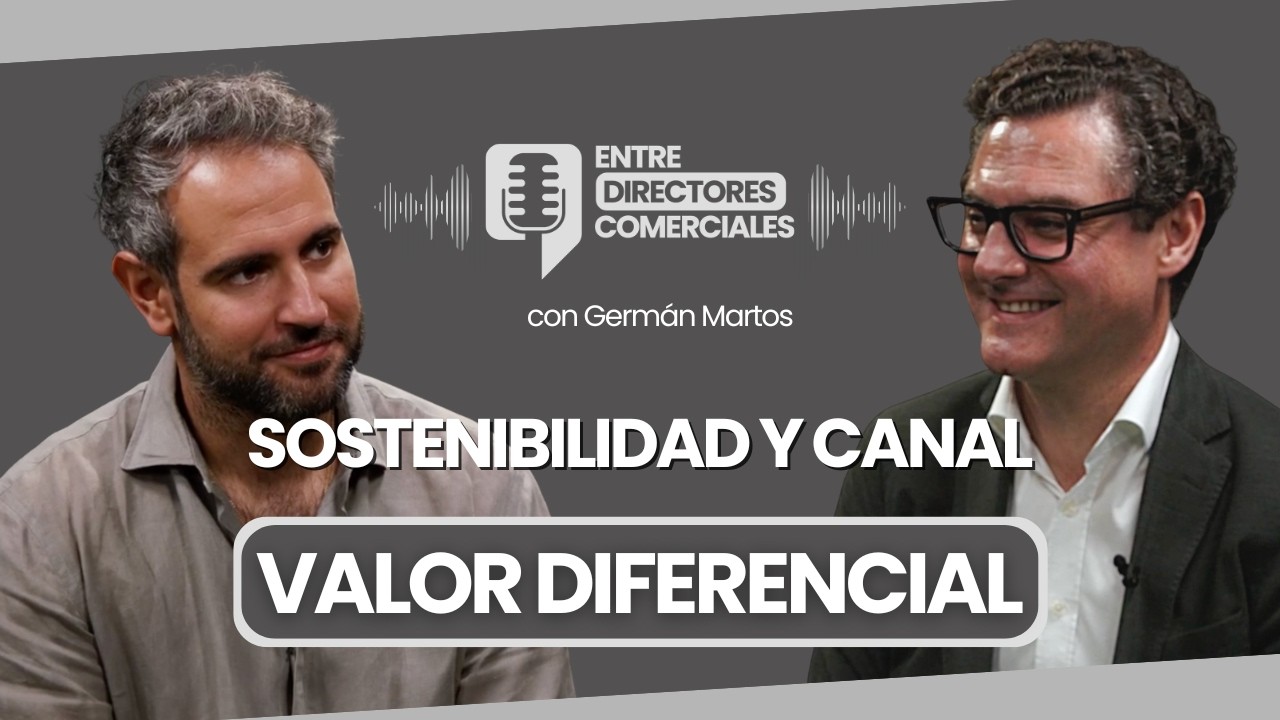
For years, choosing a distributor was simple: pick the biggest one, with the most customers and the longest track record. Today sustainability weighs more and more in that decision, but turning it into sales is another story. In this episode of Entre Directores Comerciales (in Spanish), Germán Martos, an international executive with a long career developing distribution channels in irrigation, fertilization and farm machinery, explains how to move from talk to channel KPIs.
Sustainability as a competitive advantage starts with choosing partners
Martos, an agricultural engineer, has devoted his career to three of the four levers of farm productivity: water, crop nutrition and mechanization. In his industry, sustainability is anything but abstract: you work with limited resources such as water, energy and arable land.
That's why, when choosing a distributor, the first thing he looks at is vision: whether both companies share the same idea of their place in society. Then come the technical criteria: territory coverage, resources, product knowledge, financial strength and reputation. Above all, the distributor has to internalize sustainability and be able to explain it to the end customer as the foundation of a business with a future.
Every market moves at its own pace, and the law follows
According to Martos, the differences between markets are huge. In some, sustainability is a side conversation; in the European Union it's a necessity driven by consumers, which translates into restrictions and into farm subsidies tied to more sustainable technologies. Even so, the paths converge: other markets look to Europe, and food multinationals demand the same standards everywhere.
Is it the law or the culture that drives change? For him, legislators always lag a little behind people, organizations and innovation. It's the growers themselves who discover that sustainability makes them more profitable, something that can be measured by comparing output with and without efficient technology.
From strategy to KPIs: same effort, different targets
The big challenge is turning a strategic conversation that everyone agrees with into something tactical and daily. Since every market is different, Martos doesn't set the same targets for everyone, but he does ask for the same effort. A KPI as simple as making sure everyone who represents your brand in a territory is certified to link a technology to its sustainability benefits helps shift from transactional to consultative selling.
Those KPIs have to be linked: yours must carry through to the distributor, which is an extension of your company, and from there to the grower, who today is often a large group with even higher standards. Tools help too: his company uses software that combines weather, crop needs and soil conditions, and measures how much water, energy and fertilizer each grower saves.
In farming, everything scales, because a tiny saving, when you multiply it by such an enormous surface, is huge. Any saving related to sustainability becomes massive.
When the end customer doesn't value it
Martos admits it happens every day, even against options that aren't the most price-competitive. His answer is to project long term, like someone setting up a pension plan. With those who resist, he combines two arguments: the long term, for the sustainability of the operation, and short-term savings they can see, to show that it won't cost them more, but less, and give them more.
And the distributor who sells a lot but doesn't evolve? Continuous assessment: a clear scorecard, year-on-year measurement and tough conversations when someone hits their volume targets but neglects technology adoption.
This is the slap in the face. Very often it's crystal clear to you, the whole team is fully aligned, the distributor too, but as soon as it's time to present it to the end customer, you realize they don't value it as much as you'd like.
Training the channel: repeat, certify and teach how to decide
For Martos, part of the annual budget has to go to training. You can't assume people already know: you have to repeat, with personalized certification programs for salespeople and technicians and clear development milestones. Without technology and certifications, the message doesn't get through.
And if he had to design a game for growers, he would focus it on how small decisions today have a big impact later: the diameter of a pipe determines operating costs for 20 or 25 years. He would score not the cheapest option, but the one that goes furthest over time.