


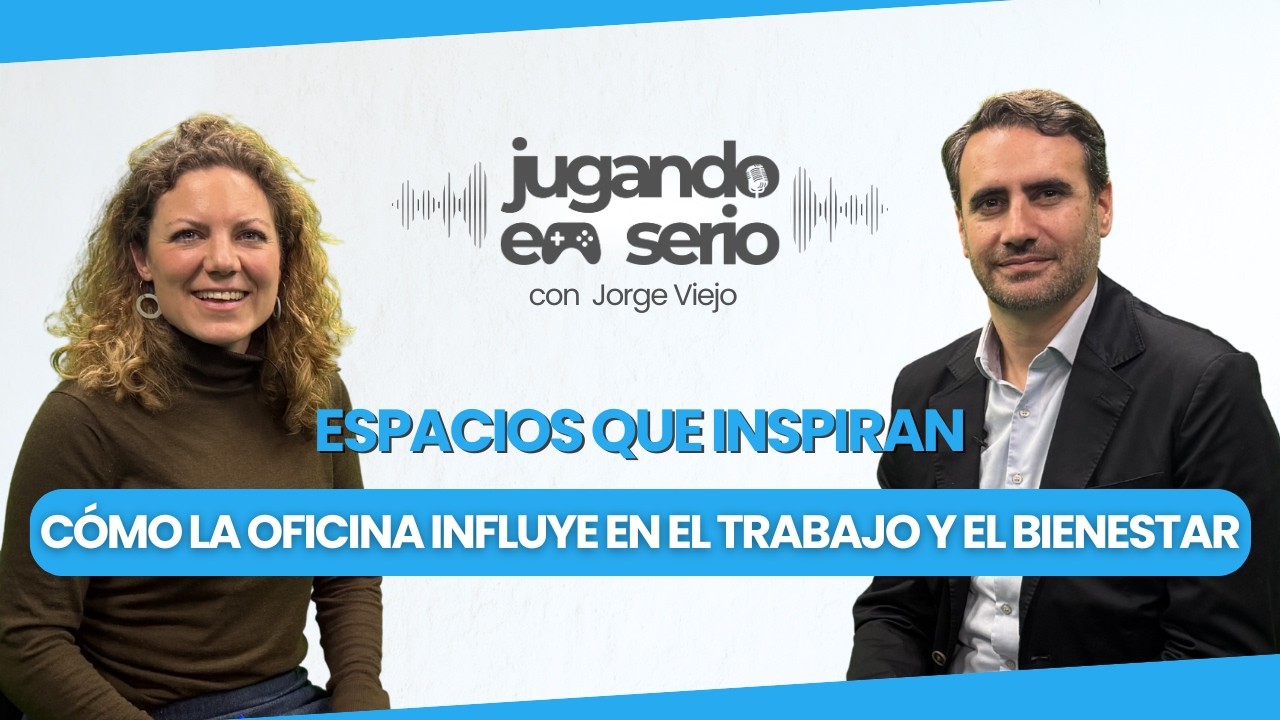
Do you finish the day exhausted even though nothing special happened? Sometimes the problem isn't the work, but the environment. In this episode of Jugando en Serio (in Spanish), Jorge Viejo, HR Director at Arup Spain, explains how office design and wellbeing are connected, and how space influences collaboration and the ability to attract talent.
What makes an office healthy
Arup Spain has gone through WELL certification, an international standard that, alongside sustainability criteria, covers social aspects and psychological wellbeing. On the physical side, it measures water, air and lighting quality; on the psychological side, issues such as flexibility and the management of stress and workload.
According to Viejo, the process helped them review what they were already doing well and strengthen the rest: more plants to bring nature indoors, or a lactation room that, even if it isn't used every day, makes all the difference to those who need it. And wellbeing is measured: regular quantitative and qualitative surveys on light, air, water and noise, plus a committee with representatives from every team that proposes improvements.
Office design that reflects company values
Arup, with 18,000 employees worldwide and around 440 in Spain, has no owner or shareholders: its founder handed ownership to the employees for a symbolic pound. Staff share in the global profits twice a year, which encourages collaboration between offices, and even the CEO serves a three-year term, renewable once.
That flat culture shows in the space: nobody has a private office, not even the CEO. There are meeting rooms anyone can book and booths for private conversations, and desks are booked through an app. A graphic designer who had been with the company for a week asked a director to leave the desk they had booked, and he simply packed up and left: the rules apply to everyone.
For us, the space has to be the physical translation of the company's values.
Open, but not noisy: collaboration and focus
How do you create an open space that encourages collaboration without turning it into a Wall Street trading floor? Arup combines open areas with meeting rooms, booths and «the fifth», an attic floor with sofas and tables for informal meetings, laptop work or lunch. It's the only place with a coffee area: if you want a coffee, you have to go up, precisely so that people get to know each other.
Teams are grouped into neighborhoods that rotate every six months or every year, because some areas have better light, others less noise or a shorter walk to the coffee. At first, the rotation triggered plenty of complaints; after the latest change, there wasn't a single comment.
Where to start without big investments
For boards reluctant to invest, Viejo suggests a simple test: would you bring your clients, your friends or your family to your office? If any answer is no, ask yourself why. For a small business in a rented office, he turns to Dead Poets Society, when the teacher asks his students to stand on the desk to see the world from another angle: sit at your team's desks and observe what they need.
Listening to staff also matters for big decisions: when they ran out of space, employees asked to stay in central Madrid, where they had built their lives, even though there were cheaper options elsewhere. And so they did.
The office also attracts and retains talent
At job fairs, Arup was competing against better-known names, so they flipped the strategy: invite students to the office to experience it. The same goes for candidates: the first interview can be on Teams, but the second is in person, and the first half hour is spent explaining the role and the company before discussing their résumé.
The logic, for Viejo, is simple: an employee changes jobs only a few times in their life, while the company hires dozens of people a year, so the decision weighs more for the candidate. Showing them their height-adjustable desk, where they'll have coffee and what view they'll have is simply being transparent.
In the interview, we're on the same level: we want to select them, but we also want to be selected by them.


