
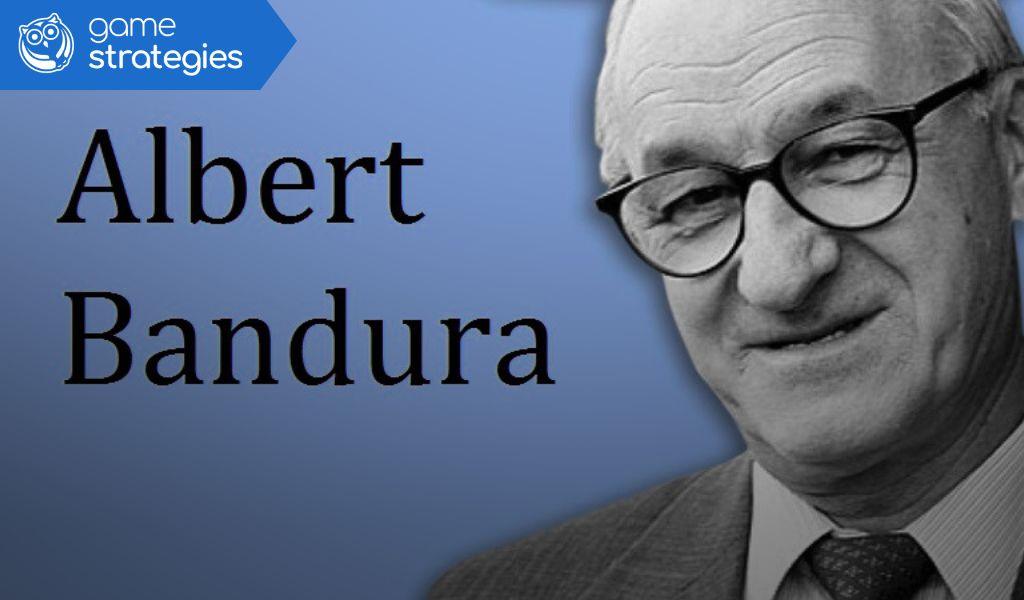
Albert Bandura showed that we learn by observing and imitating others, not only through direct experience or reinforcement, as classical behaviorism claimed. His theory rests on four processes (attention, retention, reproduction, and motivation) and on the concept of self-efficacy, the belief in one’s own ability to succeed. In corporate training, these principles explain why case studies, simulators, and peer learning outperform isolated theory.
Who was Albert Bandura, and why does he still matter
Albert Bandura revolutionized psychology by demonstrating that most human learning happens through observation and imitation, not only through direct experience. His approach brought cognitive processes into the study of behavior, something classical behaviorism had left out. Thanks to his work, psychology moved from a strictly stimulus-response view toward models that treat attention, memory, and motivation as active parts of learning.
Born in 1925 in Canada, Bandura studied Psychology at the University of British Columbia and completed his doctorate at the University of Iowa. His career unfolded in the United States, where he combined Skinner’s behaviorist tradition with Lewin’s cognitive approach to formulate Social Learning Theory: the idea that active mental processes and social interaction shape behavior simultaneously.
What Social Learning Theory says
Social Learning Theory holds that people learn by observing the behaviors, attitudes, and outcomes of others. The model proposes that the interaction between personal, behavioral, and environmental factors determines how new skills and attitudes are acquired. It marked a radical shift from behaviorism by recognizing the mind’s active role in learning.
The process involves four steps: attention, retention, reproduction, and motivation. Imitation alone isn’t enough; the observed behavior must be cognitively processed, and the learner must decide when and how to reproduce it in a real context. Observing an effective model allows people to internalize behaviors without direct experience, something Bandura demonstrated by showing how people pick up habits and strategies from leaders, colleagues, or mentors even without immediate reinforcement.
While classical behaviorism focused on stimulus and response, Bandura added active cognitive processes. This opens the door to more sophisticated training designs, like gamification, which leans on imitation and symbolic reinforcement to maximize motivation.
The Bobo doll experiment
Bandura’s best-known experiment tested whether children would reproduce aggression they saw in an adult. Children watched an adult hit a Bobo doll, then were given the chance to interact with the same doll themselves, and their behavior was analyzed.
Children exposed to the violent behavior showed more aggressive acts than the control group. Bandura concluded that learning can happen without direct interaction or reinforcement, decisively expanding training and behavior-prevention models. The study wasn’t free of criticism, particularly around the ecological validity of the lab setting and the representativeness of the sample, but its influence on educational and behavior-prevention programs has endured.
The four processes of social learning
- Attention. Without capturing the learner’s attention, there’s no starting point. Boring or poorly presented content never gets processed.
- Retention. Observed information must be stored in a way that can be retrieved later, not just recognized in the moment.
- Reproduction. The learner needs a real opportunity to practice what was observed, not just remember it.
- Motivation. Even if the first three steps are met, without a reason to act, the behavior never gets reproduced.
This framework is especially useful when designing gamified training, because it aligns learning objectives with game mechanics that reinforce each of the four stages. Bandura also pointed out that reinforcement isn’t always external: observing the positive consequences someone else receives (so-called vicarious reinforcement) can be just as effective as receiving the reward yourself. It’s the same logic behind showing success stories or team leaderboards inside a training program.
Self-efficacy theory
Self-efficacy, another core Bandura concept, is the belief in one’s own ability to handle a specific task. High self-efficacy is linked to greater perseverance and resilience in the face of obstacles, and it largely determines which activities a person chooses, how much effort they invest, and how they react to difficulty.
Four factors strengthen self-efficacy: personal experiences of success, inspiring role models, verbal persuasion (someone you trust telling you that you can do it), and the emotional state you bring to the task. That’s why scalable difficulty levels and continuous feedback, typical of a training simulator, build confidence far more effectively than an isolated theory session. When an employee overcomes a challenge in a negotiation or leadership simulator, it reinforces their belief in their own abilities, an effect that later translates into greater assertiveness in real situations.
Practical applications in corporate training
Social Learning Theory explains why certain training formats outperform others. Three areas where this shows up most:
- Peer learning. Observing more experienced colleagues facilitates mutual learning. Sharing achievements and best practices in real time, something we build into collaborative learning with Mars, is social learning applied directly.
- Building self-efficacy. Progressive challenges and symbolic rewards, typical of good gamified design, drive confidence and internal motivation.
- Modeling behavior in simulators. Watching how a model, real or simulated, resolves a difficult situation (a negotiation, a tough customer conversation, a leadership decision) lets learners internalize the behavior before facing it in the real world, without the risk of getting it wrong in front of an actual customer.
Scientific legacy
Bandura received numerous honors throughout his career, including the Grawemeyer Award in Psychology, and published more than 300 articles and five books. His notion of self-efficacy and the concept of vicarious learning remain essential references in research on motivation, leadership, and team dynamics, and their influence reaches directly into how corporate training is designed today: any simulator that lets people practice risk-free before acting in real life is, in essence, applying the same principles Bandura described decades ago.
It's the theory explaining how people learn by observing other people's behavior, not only through their own direct experience or reinforcement. It rests on four processes: attention, retention, reproduction, and motivation.
It showed that children can learn and imitate behaviors, even aggressive ones, simply by observing them in an adult, without receiving any direct reinforcement. It was a key demonstration of observational learning.
It's a person's belief in their own ability to accomplish a specific task. High self-efficacy favors perseverance, resilience, and performance in the face of challenges.
Through simulators and gamified training that let learners observe, practice, and receive feedback in a safe environment, reinforcing both the desired behavior and the learner's confidence.
¿De cuánta utilidad te ha parecido este contenido?
¡Haz clic en una estrella para puntuarlo!
Promedio de puntuación 0 / 5. Recuento de votos: 0
Hasta ahora, ¡no hay votos!. Sé el primero en puntuar este contenido.